
AFCEC plays vital role in Air Force climate plan initiatives
The Air Force Civil Engineer Center has a significant role in climate change initiatives intended to enhance resiliency at Air Force installations by addressing the risks severe weather poses to infrastructure, operational capabilities and readiness.
The initiatives were outlined in the Department of the Air Force Climate Campaign Plan. The plan breaks down the service’s strategy with specific objectives and key results. It also describes detailed actions for offices of primary responsibility, identifies external stakeholders and provides timelines to achieve results.
Released on July 11, the plan identifies three overarching priorities:
• maintain air and space dominance in the face of climate risks;
• develop a climate-informed workforce whose decisions build a climate resilient force and reduce climate risk; and
• optimize energy use and pursue alternative energy sources.
AFCEC, a primary subordinate unit of the Air Force Installation and Mission Support Center, is on pace to meet the climate plan’s objectives. Some projects are now in operation at Air Force locations around the globe.
“A lot of the initiatives in the plan involve our infrastructure, and we’ve done a lot already,” said Dr. Timothy Sullivan, chief of AFCEC’s technical services division that develops the criteria for the building performance standards of Air Force facilities.
“AFCEC recapitalizes facilities and manages construction for the Air Force,” he said. “Consequently, we’re responsible for making sound, climate-informed investment decisions that make our facilities and infrastructure resilient and enhance mission readiness in the face of climate change.”
In his role, Sullivan represents the Air Force on a tri-services committee tasked with finding solutions to risks that climate change and the environment impose on the military.
“We are working on pilot construction projects that incorporate passive design and net-zero design principles that not only enhance resiliency, but also minimize our negative impact on the global climate and the environment,” he said.
Passive design principles use the external climate to maintain a comfortable environment inside with minimal or no active lighting, heating, cooling or ventilation systems. Net-zero design elements rely on alternative energy sources, ideally reducing greenhouse gas emissions.
“We’ve completed installation energy plans and identified future projects,” Sullivan said. “The Air Force’s goal is to reduce emissions 50 percent from 2008 levels by fiscal 2033 and achieve net-zero emissions by fiscal year 2046.”
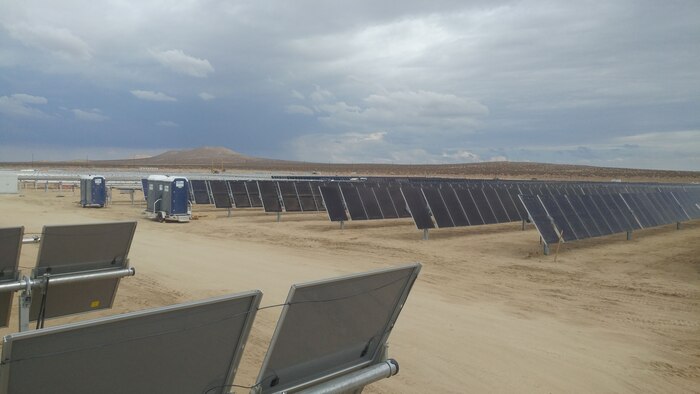
The Air Force has incorporated solar energy at several installations and is moving forward with projects at other locations that will reduce reliance on fossil fuels and provide renewable, cleaner energy.
The largest ground-mounted solar array project constructed on an Air Force installation sits on 2,600 acres at Edwards Air Force Base, California. The project was constructed by private industry under the Air Force’s Enhanced Use Lease program. It’s part of a larger, privately managed program that will displace an estimated 320,000 tons of carbon emissions annually.
The Air Force is also collaborating with private industry to explore geothermal energy solutions. Two geothermal pilot projects are expected to start soon at Mountain Home AFB, Idaho, and Joint Base San Antonio, Texas. The projects rely on promising technologies that tap into trapped heat in rock below the earth’s surface, which will enable electric power production, according to the Department of Defense.
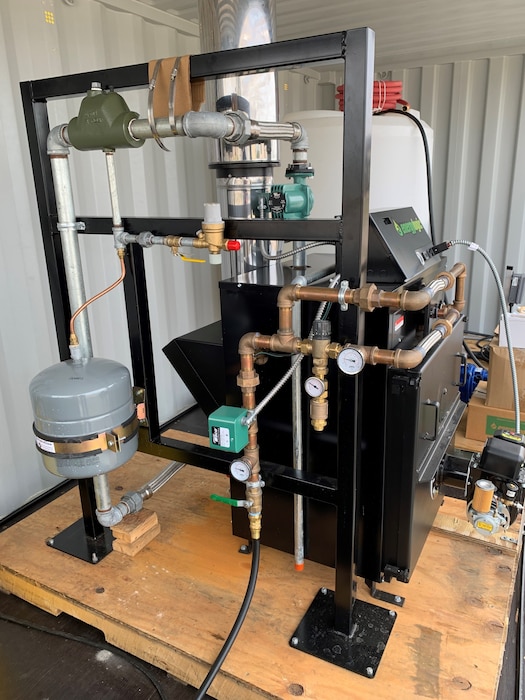
Other energy initiatives include the Green Latrine System and Waste Oil Boiler project that were initially developed by AFCEC’s Airbase Technologies Branch at Tyndall AFB, Florida.
The Green Latrine System is a containerized latrine system that operates exclusively on solar energy. Its design includes roof-mounted 3.4-kilowatt solar panels, a hybrid inverter, and an advanced energy storage system that will operate a sink, shower and toilet.
“The solar power it generates is enough to run a mini-split heating, ventilation and air conditioning system along with a light-emitting diode lighting system,” said Reza Salavani, energy program manager. “It does not rely on a power grid, making it less vulnerable to an adversarial attack.”

The idea of processing used oil to generate hot water emerged with the burden of handling hazardous waste oil at remote operating locations. AFCEC’s Waste Oil Boiler solution can provide hot water for personal hygiene, cooking and laundry, as well as larger applications like vehicle wash racks, with minimal to no environmental impact, according to EPA guidelines.
“These initiatives and others like them will fundamentally increase the resiliency of our facilities and installations, furthering their availability as power projection platforms that serve our nation,” Sullivan said.
